Shadow Lens
structure · authority · stability
The shadow The Emperor exposes
The Emperor shadow work begins with one question from this card's data: where are you using control to avoid the vulnerability of trust or change? The Emperor's gift is structure. Its shadow is structure used as armour, rules built not to make life work but to make sure nothing can surprise you.
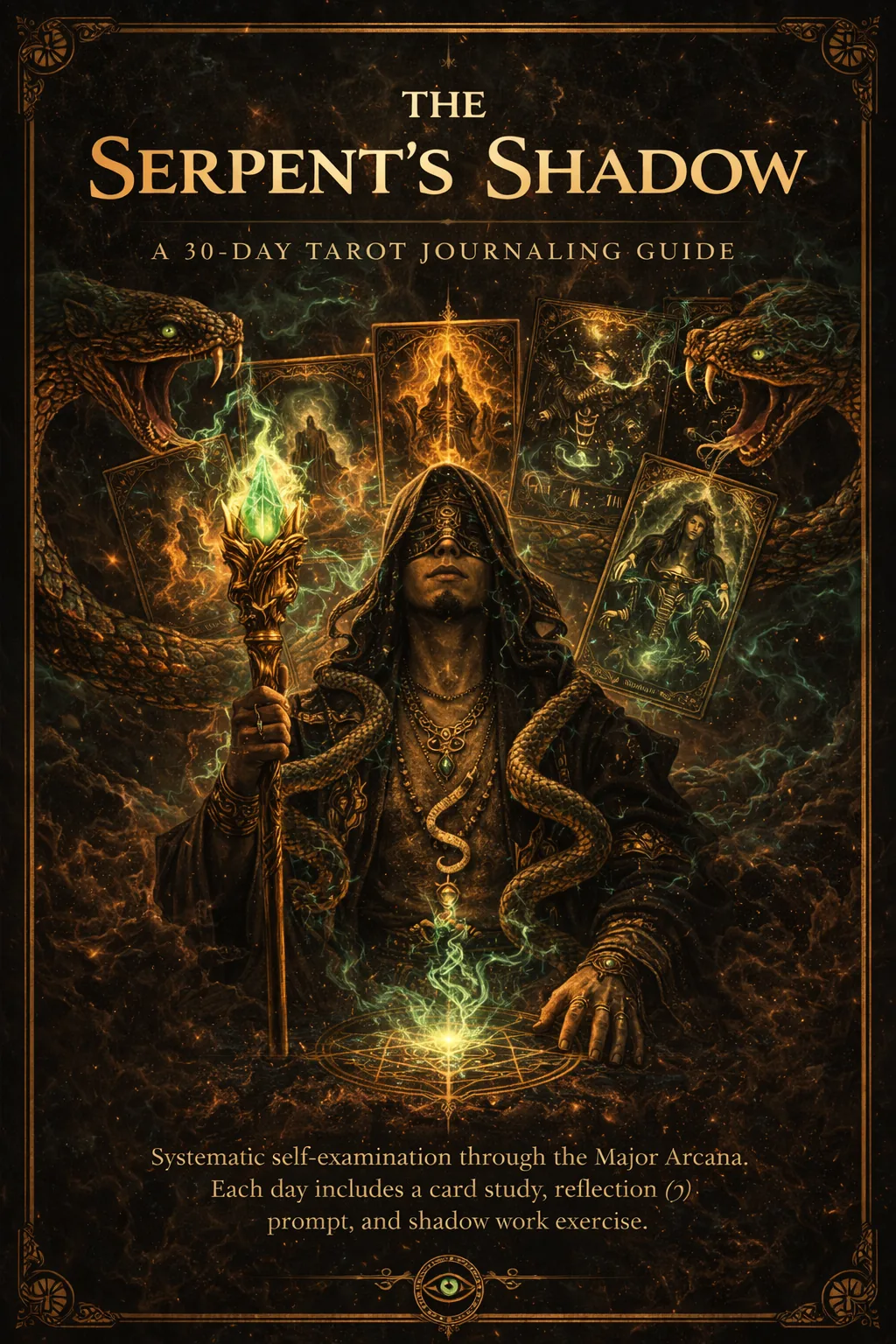
The Serpents Way image shows this shadow plainly if you look past the crown. Thick serpents coil around the figure's shoulders and behind his head, wrapped close to the body like a living mantle. He wears them as part of his authority. Serpents are energy, instinct, the parts of us that move on their own. The Emperor has not banished them; he has draped them on himself and holds very still. Shadow work here means asking what it costs to keep that much wild energy pinned in place, and whether some of it is fear dressed as command.
How it shows up in daily life
The Emperor's shadow rarely looks like tyranny from the inside. It usually looks like being responsible. Some common forms:
- Redoing other people's work because it is quicker than trusting them.
- Planning holidays down to the hour so there is no unstructured time to feel anything.
- Treating disagreement from a partner or child as disobedience.
- A harsh inner critic that runs your days like a drill sergeant.
- The opposite pattern: refusing any authority at all, including your own, because structure feels like the oppressive parent you once had.
Suppose you are the person at every family gathering who organizes the food, the seating and the timings, and you feel quietly furious that nobody helps. The shadow question is whether you leave any room for help to happen.
Journal prompts for The Emperor
- Which rule in my life would I be most afraid to break, and what do I imagine would happen if I did?
- When did I last take control of a situation that was not mine to run? What was I avoiding feeling?
- Whose authority did I grow up under, and which of their rules am I still enforcing?
- Where do I rebel against structure even when it would help me?
- What does my inner critic sound like? Would I accept that tone from a manager?
- Who in my life would say I am hard to disagree with?
- What would I let change if I trusted that I could cope with the result?
- Where do I need more structure, not less, and why have I resisted it?
Write about one concrete recent event for each prompt rather than about your personality in general. The shadow work spread can help you choose which prompt to begin with.
Exercise: hand over one decision
This is a short behavioral experiment rather than a meditation. Pick one small decision this week that you would normally make yourself: what the household eats on Thursday, how a shared document is formatted, which route you take on a walk with a friend. Hand it to someone else completely. Do not correct, suggest or sigh.
Afterwards, write down three things: what you felt in your body while waiting, what the actual result was, and how much it mattered. Many people discover the result was fine and the discomfort was the real information. That discomfort is the shadow material The Emperor is pointing to.
The Emperor reversed as shadow
Reversed, the shadow pattern is more visible. It may show up as open defensiveness, where any feedback feels like an attack on your position, or as collapse, where you have abandoned all self-discipline and feel quietly ashamed about it. Both are reactions to the same wound: a relationship with authority that never felt safe.
If you notice the collapse side, the shadow work is to rebuild one small, kind structure and keep it. If you notice the rigid side, the work is to loosen one rule and survive the result. The Emperor reversed meaning describes these two failure modes more fully.
Integrating The Emperor
An integrated Emperor keeps structure and drops the armour. You still make plans, set boundaries and hold standards, but you can explain your rules, change them when they stop working and let others share authority. Your discipline comes from respect for yourself rather than fear of chaos.
In the Major Arcana sequence, The Emperor sits between The Empress, whose shadow is smothering care, and The Hierophant, whose shadow is inherited dogma. Seen together, they trace how nurture, rule and belief can each harden into something that limits the people they were meant to serve. For the full upright meaning, read the Emperor card guide.
Common questions
What is The Emperor's shadow side?
The Emperor's shadow is the tyrant: authority without accountability and control used to avoid vulnerability. It can also appear as the absent ruler, someone who refuses any structure or responsibility because authority feels dangerous. Both patterns stem from a difficult relationship with power and trust.
How do I use The Emperor for shadow work?
Start with situations where you feel a strong urge to take charge or a strong urge to resist being told what to do. Journal about a specific recent example, notice what you were protecting, and try one small experiment such as handing a decision to someone else.
Can The Emperor represent a parent in shadow work?
Often, yes. The Emperor can bring up memories of a parent or authority figure whose rules shaped you. Shadow work with this card may involve noticing which of their rules you still enforce on yourself or others, and choosing which to keep consciously. Support from a therapist can help if this brings up painful material.
For the full upright and reversed interpretation, read the The Emperor card guide.