Shadow Lens
awakening · reckoning · calling
The shadow Judgement exposes
Judgement shadow work centres on your inner court. The card's shadow appears in two forms. In the first, you are a harsh judge who never closes the case: you keep reopening old mistakes, measuring your past self against what you know now, and handing down the same sentence again. In the second, you refuse to hold court at all, because an honest review might demand changes you are not ready to make.
Both forms keep you from the card's real gift, which is a verdict that sets you free to act. The Judgement meaning describes that gift; this page is about what blocks it.
The blindfold and the graves
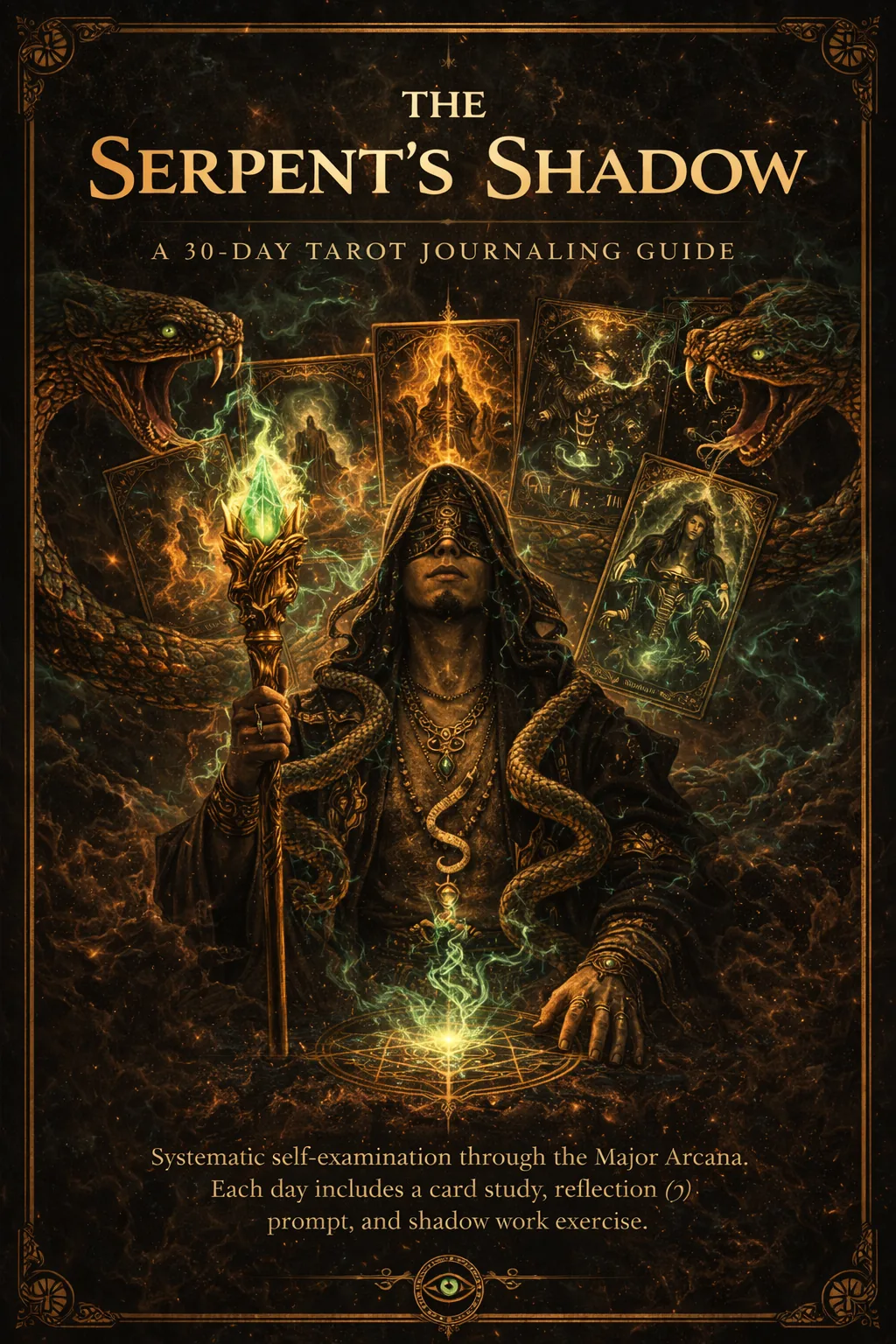
The Serpents Way image offers two details that are especially useful here. First, the figure is blindfolded. In shadow terms, that is the judge who decides without looking: "I am the kind of person who always fails," pronounced without examining the evidence. Second, grave slabs stand around the scene, and hands rise out of the ground. These are the old versions of you, the past selves still waiting for a fair hearing.
Shadow work with this card asks you to take the blindfold off your self-assessment, and to let those past selves speak rather than keeping them buried under shame.
How the shadow shows up day to day
- You apologise for things no one remembers.
- You replay one embarrassing moment from years ago whenever you try something new.
- You refuse feedback, or you hear all feedback as total condemnation.
- You describe yourself with fixed labels: "I'm the unreliable one," "I always mess it up."
- You keep busy so that you never have to look at a decision you know is overdue.
For example, someone who failed an exam at nineteen may still decline every training opportunity at forty, explaining that they are "not academic." The verdict was reached once and never reviewed.
Journal prompts for Judgement
- What am I still punishing myself for, and how long have I been serving that sentence?
- If a close friend had done what I did, what would I say the fair consequence was? Have I already paid it?
- Which label about myself did I accept as a verdict without checking the evidence?
- What review of my life am I avoiding, and what do I fear it would require me to change?
- Who from my past still lives in me as a judge? Whose voice is it?
- What have I learned from my worst mistake that I could only have learned that way?
- What would taking responsibility look like, as opposed to feeling guilty?
- If I accepted that the case was closed, what would I do next week?
Work through two or three at a time. The shadow work spread can give your writing a structure if you prefer to start with cards.
A grounding exercise: closing the case
Write down one specific thing you still judge yourself for. Underneath, write three columns: what happened, what you have done since to repair or learn from it, and what is still genuinely outstanding.
Most people find the third column is shorter than expected. If something is outstanding, such as an apology owed, name one concrete step and a date. Then write at the bottom: "This case is reviewed and closed." Read it aloud. Repeat with another memory on another day. This turns endless self-judgement into the responsibility the card actually asks for.
Judgement reversed in shadow work
Reversed, the shadow is more entrenched. Unfinished absolution is the theme: you may have done the repair work but cannot accept that it counts. Or you may be delaying the review so long that the opportunity it would unlock passes by. The Judgement reversed page covers these patterns in more depth, and The Hermit shadow work is a useful companion if your avoidance takes the form of withdrawal.
Integrating the work
Integration with Judgement means your past becomes evidence rather than a charge sheet. You can name your mistakes plainly and use them. The test is behavioural: do you take the opportunity you used to refuse? Do you accept a compliment without arguing? When the inner court stops sitting every day, you have more energy for the life the card is calling you toward.
Common questions
What is Judgement shadow work about?
It is about the way you judge yourself. The shadow shows up either as constant self-condemnation for past mistakes or as avoiding honest self-review altogether. The work is to replace both with fair assessment that leads to responsibility and action, instead of guilt or denial.
What journal prompt fits Judgement best?
A strong starting prompt is: What am I still punishing myself for, and what would taking responsibility look like instead? It separates guilt, which keeps you stuck, from responsibility, which leads to a specific action. Most other Judgement prompts follow from that distinction.
How is Judgement shadow work different from Justice shadow work?
Justice focuses on fairness, accountability and how you treat others. Judgement focuses on your relationship with your own past and whether you can accept a verdict and move on. Justice asks whether you were fair. Judgement asks whether you will let yourself rise after the review.
Can shadow work with Judgement be overwhelming?
It can, because it brings up regret and old memories. Work slowly, with one memory at a time, and stop if you feel flooded. If guilt or shame is affecting your daily life, consider speaking to a qualified therapist alongside any journalling practice.
For the full upright and reversed interpretation, read the Judgement card guide.