Spiritual Lens
stalemate · guarded balance · pause
The Two of Swords spiritual meaning
The spiritual meaning of the Two of Swords is the practice of holding contradiction. You carry two understandings of yourself or the world that do not fit together, and the card asks you not to drop either too soon. It is the moment before integration, uncomfortable because nothing is resolved and valuable for the same reason.
The main guide to the card calls this the threshold before synthesis. The inner work is tolerance of tension rather than solving it.
What the imagery carries
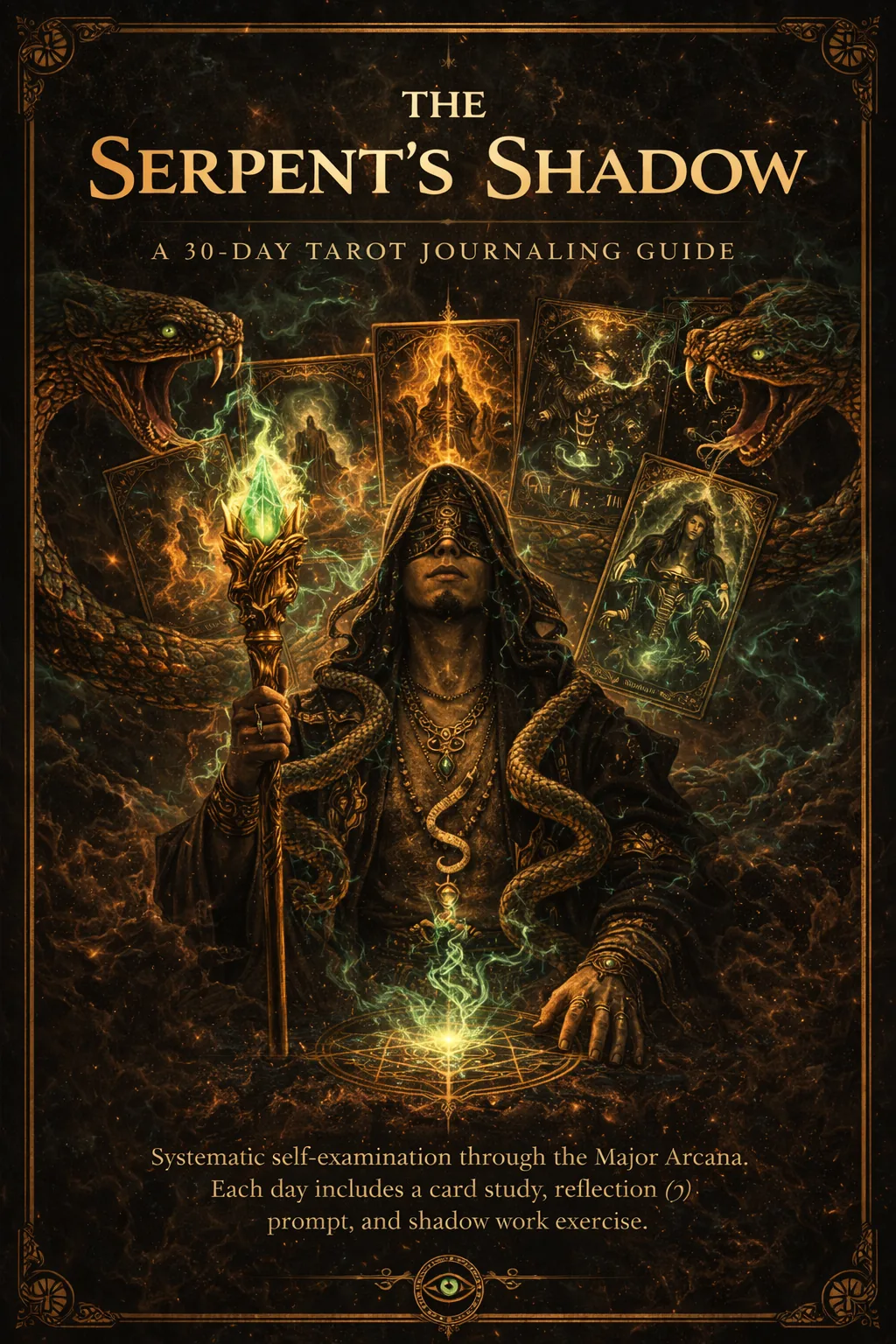
This deck's version is rich in detail. Behind the figure's head a faint geometric circle glows, like a halo drawn with a compass, and the two swords rise through it on either side. Whatever is sacred in the picture sits behind the blindfold, not in front of it. The figure is not looking outward for an answer; attention has turned inward.
Serpents wind around both crossguards, and a pale green gem marked with a star sits in each hilt. The two weapons are twins. Neither is the true one and the other false. Green energy crackles around both blades and into the dark around them, so the stillness of the figure is surrounded by movement. The calm is chosen, not empty.
The lesson of the number two
In the Minor Arcana, twos are the first meeting of a suit's energy with something other than itself. For Swords, the suit of Air and mind, that meeting is a thought confronting its opposite. The Ace of Swords is a single cutting insight; the Two is the discovery that a second insight cuts just as sharply.
There is a link here to the High Priestess, card two of the Major Arcana, who sits between two pillars. She rests in the tension; the figure in the Two of Swords is still working to hold it. Both suggest that some knowing only arrives when you stop forcing a choice.
Air, mind and the spiritual path
Swords belong to Air, and Air in tarot is the element of thought, language and judgement. Spiritual traditions often treat the thinking mind as an obstacle, but the Two of Swords takes a more balanced view. The mind is the instrument that notices contradiction in the first place. Without it, you would never see that two of your beliefs pull against each other.
The difficulty comes when the mind tries to settle the matter by argument alone. You build the case for one side, then for the other, and the two cases cancel out. This is the stalemate the figure is holding. The card suggests putting the arguments down for a while, not to abandon thinking but to let another kind of knowing, slower and quieter, come forward.
In practice this might mean noticing which option your body relaxes toward, or which one you return to in daydreams. These are not infallible guides, but they add information the arguing mind leaves out.
Signs this energy is active
- You hold a belief you were raised with and a newer one that contradicts it, and both feel true.
- Meditation or prayer feels flat because you are avoiding one particular thought.
- You keep asking the cards the same question, hoping for a different draw.
- You feel peaceful about a decision only as long as you don't think about it.
None of these signs means something is wrong. They simply show that the tension is present and asking for attention rather than another distraction.
Reversed spiritually
Reversed, the spiritual side of the card becomes inner split. Instead of patiently holding two truths, you swing between them, or you numb yourself so you feel neither. It can show spiritual bypassing, using calm or detachment to avoid a decision that belongs to ordinary life. It can also show a breakthrough, the blindfold slipping and a long-held contradiction resolving all at once. The reversed meaning describes both.
A short practice: the two-hand meditation
Sit with your hands resting palm up on your knees. Name one side of your contradiction and let it rest in your left hand. Name the other and let it rest in your right. Breathe slowly for a few minutes without letting either hand become heavier or lighter in your mind.
Then ask, without answering at once: what would make room for both? Write down whatever comes, even if it seems small. Repeat over several days. The aim is not a verdict but a third position, a way of seeing in which both truths have a place. If you prefer cards, draw one for each hand and a third between them, a simple variation on the three-card spread.
Be patient with the process. Contradictions that took years to form rarely resolve in one sitting, and part of the card's lesson is that holding them gently is already spiritual work.
Common questions
What does the Two of Swords mean spiritually?
It means holding two contradictory truths without forcing an early resolution. The card marks the threshold before integration, where tension is uncomfortable but necessary. The practice is to stay with both sides long enough for a broader understanding to emerge, rather than choosing one just to end the discomfort.
Why is the figure blindfolded in the Two of Swords?
The blindfold shows attention turned inward and a refusal to be swayed by outside appearances. It can mean wise inner listening or deliberate avoidance. Spiritually the question is which one it is for you right now, and whether you are ready to look.
What is the spiritual meaning of the Two of Swords reversed?
Reversed, it suggests inner conflict that has become unmanageable or calm used to avoid real choices. It can also mark a sudden resolution, when a long-held contradiction gives way and you see how the two sides fit together.
For the full upright and reversed interpretation, read the Two of Swords card guide.