A reversed tarot card is not automatically negative. Depending on your chosen method, it may signal blocked energy, an internalized version of the card's theme, a delay, or simply a card you choose to read the same as upright. Pick one consistent approach, apply it to the whole reading, and the reversal stops being a source of dread.
- What a reversed card actually is
- Do you have to read reversals at all?
- Three practical approaches to reversals
- Approach 1: Blocked or delayed energy
- Approach 2: Internalized or hidden expression
- Approach 3: Shadow or distorted expression
- Reversed Major Arcana cards
- Reversed Minor Arcana and court cards
- How surrounding cards change reversal meaning
- What does it mean if most or all cards are reversed?
- A worked example: how reversals shift a reading
- Common reversal mistakes to avoid
- Choosing and sticking to one system
What a reversed card actually is
A reversed tarot card is a card that has landed upside down during a shuffle or draw. That is the mechanical reality. What it means interpretively depends entirely on the reader's chosen framework. There is no single authoritative tradition. Some lineages read all cards upright. Some readers assign reversed cards opposite meanings. Some use reversals to mark internalized energy, resistance, or a theme that is present but not yet visible.
Because there is no single standard, the first and most important decision a reader makes about reversals is whether to use them at all, and if so, which framework to apply consistently. A reader who shifts between systems mid-reading will produce noise, not insight.
Do you have to read reversals at all?
No. Many experienced readers choose not to use reversals and produce clear, layered readings without them. The 78 upright cards already carry a full spectrum of meaning, including challenge, delay, fear, and shadow themes. Cards like the Five of Pentacles, the Nine of Swords, and The Tower describe difficulty without needing to land sideways to do so.
If you are a beginner still building card fluency, it is perfectly reasonable to shuffle in one direction and read every card upright. Reversals add a layer of complexity that is only useful once you have a stable sense of the card's core meaning. Learn the deck's language first. Add reversals when the upright meanings feel genuinely familiar, not before.
If you do choose to use reversals, the card has to be able to reverse during a shuffle. This means cutting the deck freely rather than always flipping it in the same direction. Many readers who claim to "use reversals" inadvertently shuffle in a way that makes reversals impossible.
Three practical approaches to reversals
These are the three most common and coherent frameworks. Each one produces different readings of the same reversed card. None is objectively correct. Pick the one that fits your reading style and apply it consistently.
Approach 1: Blocked or delayed energy
In this system, a reversal means the card's energy is present but not flowing freely. The upright Three of Wands reversed, for example, might describe a plan that exists but cannot move forward yet — the horizon is in sight but the path is obstructed. The Ace of Pentacles reversed might show a practical opportunity that has been suppressed, declined, or not yet recognized.
This approach works well for questions about timing and practical circumstances. It does not turn the card into its opposite. It shifts the card from active to held. The energy is real, but something is preventing it from expressing fully. That something might be external (bad timing, another person's decision) or internal (fear, avoidance, unreadiness).
This is one of the more forgiving reversal frameworks because it keeps the card's core meaning intact while adding useful nuance about the current state of that energy in the querent's life.
Approach 2: Internalized or hidden expression
In this system, a reversal suggests the card's theme is happening privately, internally, or below the surface rather than in the visible world. The Six of Cups reversed might describe nostalgia the querent has not spoken aloud. The Strength card reversed might show self-discipline or courage being practiced quietly, without external recognition. The High Priestess reversed might point to intuition the reader is suppressing or not trusting.
This approach suits psychological and self-reflective readings well. It is particularly useful in Jungian-oriented work where the cards are being used to surface unconscious patterns rather than predict events. When a card is reversed under this system, the reader asks: where is this quality hiding in the querent's inner life, and what is keeping it from becoming visible?
Approach 3: Shadow or distorted expression
In this system, a reversal shows the card's energy expressed in a distorted, excessive, or shadow form. The reversed Emperor might describe rigidity, authoritarianism, or control used as a substitute for real security. The reversed Two of Cups might show a bond that appears mutual but runs primarily in one direction. The reversed Temperance might describe imbalance, compulsion, or refusal to moderate an impulse that is causing damage.
This is the most psychologically demanding of the three frameworks. It requires the reader to identify not just what the card means but what happens when that meaning becomes distorted or excessive. It aligns closely with shadow work and is most valuable when the reading is specifically exploring a pattern the querent already suspects is unhealthy.
Reversed Major Arcana cards
Reversed Major Arcana cards carry particular weight because the Majors describe deep patterns, life forces, and archetypal transitions. A reversed Major usually does not mean the theme disappears from the querent's life. It means the theme is being resisted, misapplied, avoided, or is in the process of becoming conscious.
- The Fool reversed: Recklessness, refusal to begin, fear masking as caution, or naivety mistaking itself for wisdom.
- The Magician reversed: Misdirected will, manipulation, incomplete use of available resources, or energy without focus.
- The High Priestess reversed: Suppressed intuition, surface-level decisions, avoidance of what the inner life is signaling.
- The Empress reversed: Creative block, neglect of the body or environment, overdependence or withholding of care.
- The Emperor reversed: Rigidity, abuse of authority, weak boundaries masquerading as strength, or external structure collapsed.
- The Hierophant reversed: Rejection of tradition without a replacement framework, unconventional but directionless, or dogma turned inward.
- The Lovers reversed: Misaligned values, avoidance of a real choice, commitments that do not reflect actual priorities.
- The Chariot reversed: Loss of direction, competing drives pulling in opposite directions, willpower without steering.
- Strength reversed: Force substituting for patience, inner courage suppressed, or anger undirected.
- The Hermit reversed: Isolation becoming avoidance, wisdom withheld out of fear, or withdrawal that has stopped being useful.
- Wheel of Fortune reversed: Resistance to change, feeling stuck in a cycle, or denial that circumstances are shifting.
- Justice reversed: Unfair outcome, accountability avoided, or imbalance that has not yet surfaced publicly.
- The Hanged Man reversed: Suspension without growth, refusal to wait, or a sacrifice resisted despite being necessary.
- Death reversed: Clinging to what is already over, inability to release, or a transformation stalled at its edge.
- Temperance reversed: Imbalance, compulsion, the refusal to moderate or integrate conflicting parts.
- The Devil reversed: Breaking free from a binding pattern, or a bondage so familiar it has not yet been recognized as binding.
- The Tower reversed: Avoiding a collapse that is coming anyway, or a disruption reduced in scale but not avoided.
- The Star reversed: Dimmed hope, despair mistaken for realism, difficulty accessing trust in a longer arc.
- The Moon reversed: Confusion clearing slowly, fears losing their grip, or illusions beginning to dissipate.
- The Sun reversed: Delayed clarity, blocked expression, joy present but not yet accessible.
- Judgement reversed: Refusal to heed an inner call, a reckoning being avoided, or the failure to act on a clear realization.
- The World reversed: Completion stalled near the finish line, integration interrupted, or success achieved but not fully inhabited.
For full upright meanings, see the complete Major Arcana guide.
Reversed Minor Arcana and court cards
Reversed Minor Arcana cards tend to be more situational than reversed Majors. Because the Minors describe everyday events and patterns, a reversal usually shows a smaller, more localized disruption — a plan stalled, an emotion suppressed, a practical step missed rather than a whole life pattern at stake.
A few principles that hold across the suits:
- Reversed Aces typically show a potential not yet available or a seed that has not broken ground. The opening exists, but access is blocked or the timing is not right.
- Reversed tens often describe endings that have not been cleanly completed. The cycle wants to close but something is keeping it open — unfinished grief, unacknowledged success, or a story the querent keeps re-entering.
- Reversed fives and sevens, already cards of challenge or conflict, may show that the difficulty is becoming worse, more internal, or harder to externalize productively.
Court cards reversed are some of the most misread reversals in the deck. A reversed court card does not usually mean the person that card represents is absent or malevolent. It more often means the qualities of that court card are present in an undeveloped, excessive, or misapplied form. A reversed Knight of Swords might describe recklessness or argument for its own sake. A reversed Queen of Cups might describe emotional withdrawal or the collapse of the care that card usually extends toward others. For a full breakdown of suit energy, see the Minor Arcana guide.
How surrounding cards change reversal meaning
A reversed card never exists alone. Its neighbors in the spread provide context that can dramatically change what the reversal is pointing to.
Consider the reversed Ace of Cups. On its own, this might suggest emotional opening is blocked. But sitting next to the Four of Swords, it may indicate that the person is in a necessary period of rest before the emotional opening becomes possible — the reversal is about timing, not permanent closure. Next to the Five of Swords, the same reversed Ace might suggest a tender beginning was damaged by conflict. Next to The Star, it may point to hope returning slowly, the heart cautiously reopening.
This is why reading cards in combination matters more than reading each card in isolation. The reversal gives you a texture. The surrounding spread gives you a direction. Both together give you something you can actually use.
What does it mean if most or all cards are reversed?
A spread where the majority of cards land reversed is one of the more anxiety-inducing moments for newer readers. The instinct is to read it as a warning sign — something is deeply wrong, the reading itself is cursed, or the shuffle went badly. None of those is the right interpretation.
A high proportion of reversed cards most often signals one of two things. First, the querent may be in a period where energy is widely suppressed or turned inward. Major life transitions — grief, recovery, burnout, a pause after a long effort — tend to generate spreads with many reversals because the querent is genuinely operating at reduced external capacity. The reversals are accurate. They are showing that things are held, waiting, or not yet ready to move. That is not a catastrophe; it is a description of where the person is.
Second, a spread heavy with reversals may indicate that the question itself is asking about something internal rather than external. If the question is about feelings, fears, or a decision that is still being processed privately, the deck will often respond with internalized energy — which shows up as reversals. The reading may be trying to say: this is still happening inside you, not out in the world yet.
A fully reversed spread — every single card upside down — is rare but not ominous. Treat it as an amplified version of the above: the reading is pointing strongly toward blocked or withheld energy, deep internal processing, or a situation that has not yet surfaced. Consider reformulating your question to ask about inner experience rather than external outcome, and try again.
What it does not mean: the deck is broken, the shuffle was wrong, you need to redo the reading. If you pulled the cards intentionally using your system, the spread is valid.
A worked example: how reversals shift a reading
Here is a three-card reading — past / present / future — on the question "what is happening with my creative work?" — shown twice, once with all cards upright and once with two of three reversed, to illustrate how the reversal layer shifts the interpretation.
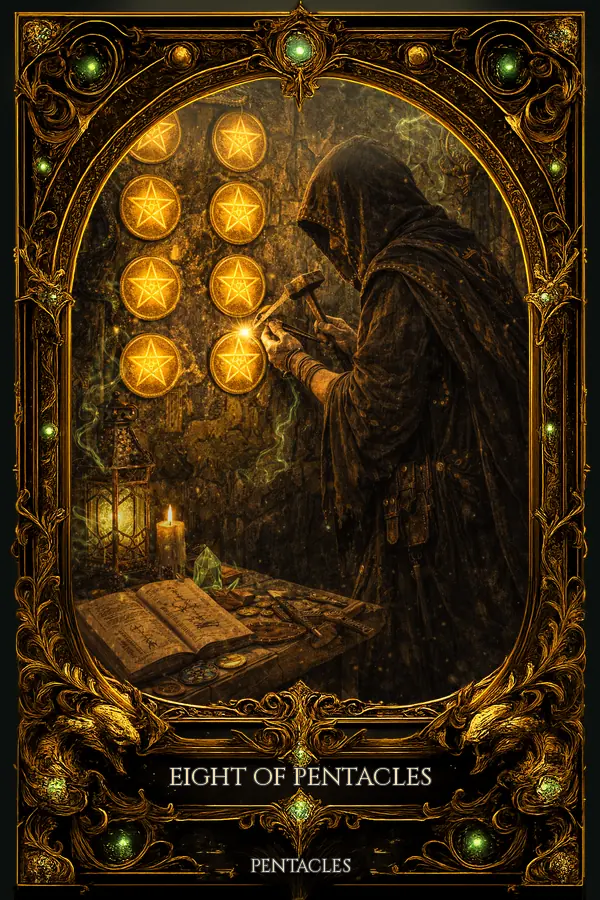
Upright version: Eight of Pentacles / Three of Cups / Ace of Wands.
Read upright, this spread is largely positive. The Eight of Pentacles in the past position shows a sustained period of focused practice — the querent has been diligently working, developing craft. The Three of Cups in the present shows celebration, collaboration, and a moment of coming together with others around the work. The Ace of Wands in the future position suggests a new creative ignition is coming — appetite, a new project, a fresh surge of inspiration.
Reversed version: Eight of Pentacles / Three of Cups reversed / Ace of Wands reversed.
The Eight of Pentacles stays upright and anchors the reading: the querent has done genuine work. That foundation is real. But the Three of Cups reversed in the present shifts noticeably. Instead of community and celebration, it may now suggest that the creative connection the querent hoped for has not materialized — they are working in isolation, or a collaboration has stalled, or external recognition has not arrived despite the effort. The Ace of Wands reversed in the future slot does not erase the creative possibility, but it delays it. The ignition is present but not yet accessible — something needs to clear first before that new energy can land.
The reversed reading is not worse news in some absolute sense. It is more specific. It names what is actually happening: isolation in the present, a beginning that is close but not yet available. That is more useful than a spread that simply promises good things ahead.
This is the practical value of reversals. They give you texture the upright reading sometimes flattens.
Common reversal mistakes to avoid
Several patterns appear repeatedly in readers who are struggling with reversals.
Treating every reversal as bad news. Some of the most difficult upright cards — the Five of Cups, the Ten of Swords, the Moon — do not become pleasant when reversed. And some of the most positive cards reversed simply show their energy is less available right now, not that the situation has turned. A reversed Sun is not a dark outcome. It is a dimmed one.
Switching systems mid-reading. If you start a reading using the blocked-energy approach and switch to shadow interpretation halfway through, your reading becomes internally inconsistent. Pick your framework before you shuffle and stay with it.
Inventing opposite meanings on the fly. A reversed card is not simply the opposite of the upright card. The opposite of Strength is not weakness in any simple sense. The opposite of The Lovers is not hatred. Opposites produced without a coherent system are noise.
Reading reversals as the dominant signal when the upright cards tell the story more clearly. If you pull six cards and three are upright and direct, those three cards may be the actual answer. The reversals may be context. Do not let reversed cards dominate the reading by giving them disproportionate weight.
Choosing and sticking to one system
The best reversal system is the one you apply consistently and understand clearly. Most readers settle into one of the three approaches described here — blocked energy, internalized expression, or shadow distortion — and that approach becomes part of how they read the deck.
If you are just beginning, start without reversals entirely. Read all 78 cards upright until each card carries real weight for you. Then introduce reversals when the system can support the added layer. The goal is not to use every feature of the deck simultaneously. It is to build a reading practice that produces genuine clarity.
Once you choose a system, write it down somewhere you can reference it. Even experienced readers can drift between frameworks when the reading gets confusing. Anchoring your approach to something written makes it easier to return to when a spread gets complex.
If you are building a daily practice, the daily tarot reading guide covers how to structure consistent single-card work — a good environment for testing how reversals land when you are seeing the same cards repeatedly over weeks of draws.
And if you want to explore how the shadow themes that reversals often surface connect to the deeper psychological work the deck supports, the tarot as psychological mirror article covers that territory in more depth.